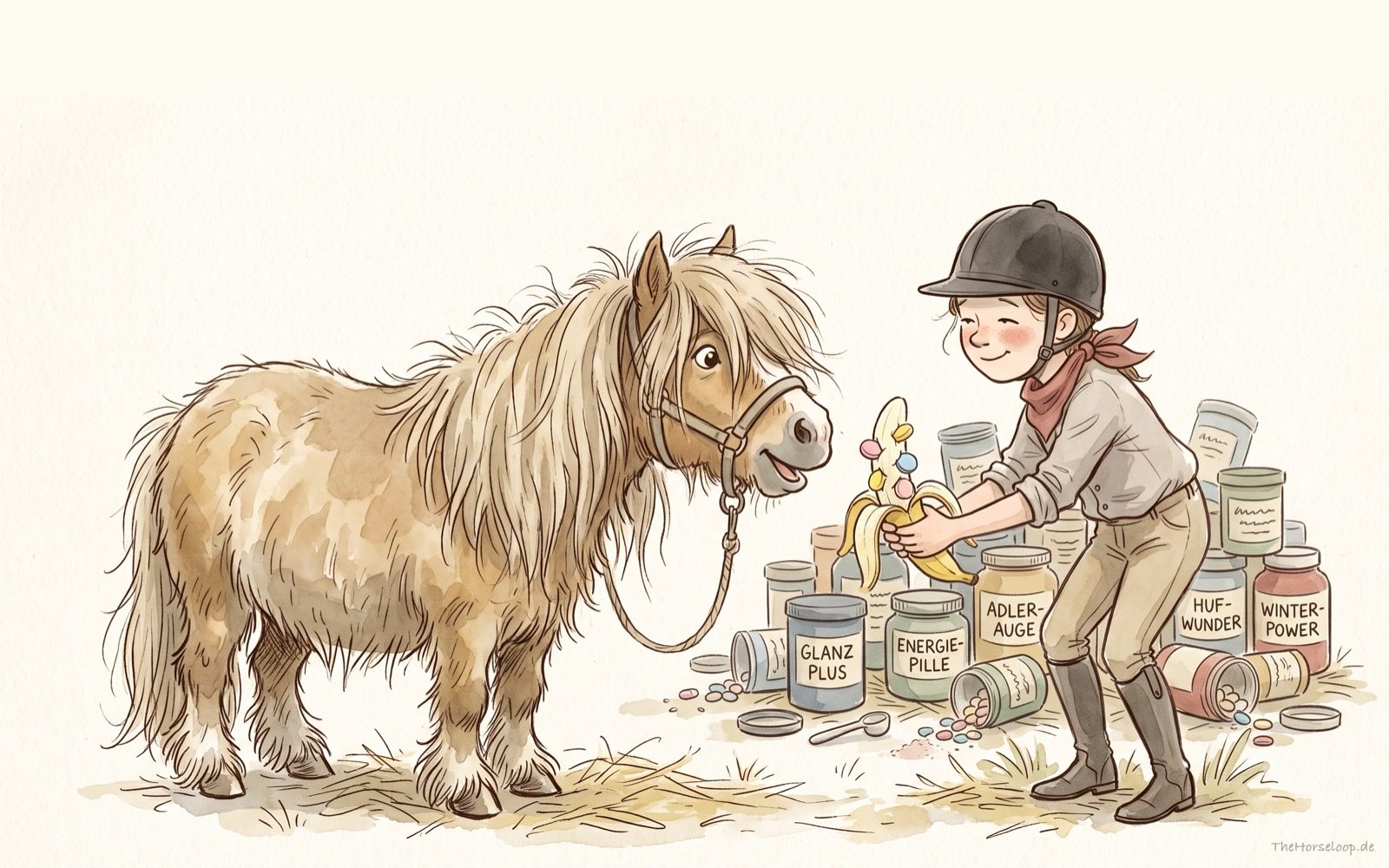
What does “low-carb” mean for horses?
Low-carb horse feeding does not mean cutting carbohydrates across the board, because they make up most of a horse's natural diet. The focus is on the non-structural carbohydrates, NSC for short.
NSC is an umbrella term for the easily digestible carbohydrates in the diet: water-soluble carbohydrates (WSC), which include sugar and fructan, plus starch. These are broken down quickly in the small intestine or by bacterial fermentation in the large intestine, and they can strongly affect blood sugar and insulin levels. That is exactly the problem in horses with metabolic disorders.
Structural carbohydrates such as cellulose and hemicellulose from hay and straw, on the other hand, are fermented slowly in the large intestine into volatile fatty acids and supply the main energy of a healthy horse. They are not up for discussion when we talk about “low-carb.” The crude fiber base stays in place.
When does reducing NSC make sense?
Not every horse needs a low-carb diet. For healthy sport horses with normal insulin metabolism, a moderate NSC intake is no problem at all. It looks different for horses with certain conditions or risk factors.
Equine metabolic syndrome (EMS)
The central feature of EMS is insulin dysregulation (ID), a disturbed regulation of insulin metabolism that drastically increases the risk of laminitis [1]. The most important therapeutic measure in EMS is an adapted diet with reduced NSC content [1]. The 2019 ECEIM consensus statement recommends, depending on the severity of the insulin dysregulation, an NSC content of 10–12% of dry matter, and even below 10% for high-risk horses [1]. The newer 2024 recommendations of the Equine Endocrinology Group consistently name an NSC content below 10% for hay and explicitly define NSC as the sum of water-soluble carbohydrates and starch [7].
Important in practice: Some severely affected horses still respond to such hay with insulin values that are too high. Only an insulin measurement about two hours after feeding shows this reliably, and it is also the way to test a new feed on an individual horse [7]. In winter, insulin values tend to be higher, so that is exactly when you should not add NSC-rich feeds on top [7].
PPID (equine Cushing's disease)
Horses with Pituitary Pars Intermedia Dysfunction (PPID) also often develop insulin dysregulation and are particularly prone to laminitis. The feeding principles are therefore similar to those for EMS: NSC-reduced rations are part of standard therapy.
History of laminitis
Horses that have already gone through one or more laminitis episodes are at particular risk. NSC-rich feeds and pasture grass can amplify the insulin response and thereby raise the risk of further flare-ups [2][3]. Lasting NSC control is necessary here as prevention.
PSSM (polysaccharide storage myopathy)
In this genetic muscle disease, excessive storage of glycogen in the muscle leads to painful muscle damage. Horses with PSSM type 1 benefit from a low-starch, higher-fat diet in which NSC from grain is drastically reduced.
Preventive for genetically predisposed breeds
Hardy breeds such as Icelandic horses, Shetland ponies and Norwegian Fjords, but also some Quarter Horses and Morgan Horses, are genetically prone to insulin dysregulation. Even when there are no symptoms (yet), moderate NSC control can lower the risk of disease in the long term.
Hay as the foundation: why the analysis is critical
Hay is the foundation of any horse-friendly feeding, especially with a low-carb diet. But not all hay is the same. NSC content varies enormously depending on cutting time, grass species, weather and fertilization. NSC values can reach over 400 g/kg dry matter in pasture grass [3] and can be well below that in late-cut hay.
For horses with insulin dysregulation, a hay analysis is a must, not an optional extra. It is the only way to know reliably whether your hay stays within the recommended limits. Some labs offer low-cost rapid tests designed specifically for horse hay. ESC (ethanol-soluble carbohydrates, sugar only), WSC (water-soluble carbohydrates, sugar plus fructan) and starch are reported separately.
Soaking hay: a rule of thumb with limits
The Equine Endocrinology Group recommends soaking hay in cold water for at least 60 minutes whenever the analysis shows more than 10% NSC or no analysis is available [7]. How much that helps is hard to predict, though: in a British study, hay samples lost on average 27% of their water-soluble carbohydrates (WSC) after up to 16 hours, but the range was 6 to 54%, and several samples were still above 10% WSC afterward [19]. Soaking helps, but it offers no guarantee. If you want to be on the safe side, you can't get around a hay analysis, ideally before and after soaking.
Steaming does not replace soaking: in a direct comparison, the WSC content of steamed hay stayed practically at the level of dry hay [20].
Important: soaked hay needs to be fed promptly. In summer, it can spoil within a few hours.
Straw: the underrated building block
Clean, mold-free straw contains hardly any sugar and starch and little energy. The Equine Endocrinology Group now explicitly lists it as a building block of the EMS ration: up to about half of the forage can be good straw, mixed with the hay [7]. In a Swedish crossover study with six horses, a straw share of 50% did not change the gastric mucosa findings; eating time got longer, and energy intake and insulin values dropped [11]. A British study in native ponies specifically examined straw as a means of weight loss [12].
The conditions matter: introduce it gradually over at least two weeks, watch fecal output and signs of colic [7], use it only with intact dentition, and never as the sole forage. Pure straw feeding was linked to more gastric ulcers in an earlier field study [11].
Concentrate feed: what works, what doesn't?
Oats, barley and corn are classic grain feeds, and off limits for horses with insulin dysregulation, EMS or a history of laminitis. The high starch content drives insulin levels up. In horses with insulin dysregulation, NSC amounts above 0.1 g/kg body weight per meal lead to clearly elevated insulin responses [4][8].
This shifts the focus from the percentage to the amount: in a follow-up study with pelleted feeds between 7 and 45% NSC, horses with insulin dysregulation responded excessively from about 0.11–0.12 g NSC per kg body weight per meal, regardless of how low in NSC the feed itself was [8]. Even small portions of feeds with low to moderate NSC content can release a disproportionate amount of insulin in these horses [9].
As a rule of thumb: body weight times 0.1 g gives the NSC budget per meal. For a 400 kg (880 lb) horse that is 40 g: with a feed at 7% NSC about 570 g of dry matter, at 12% about 330 g, at 22% only about 180 g. The variation between individual horses was large in the studies; the formula does not replace insulin monitoring in your own horse.
Low-NSC alternatives
Unmolassed beet pulp (soaked before feeding) is a popular energy source with low NSC content. It provides highly digestible pectins and fibers but is low in sugar and starch.
Hay cubes and hay pellets made from late-cut grass provide structured energy without NSC spikes. Check the label, since not all products are equally low in NSC. In a feeding study, small amounts of low-NSC hay pellets did not trigger an excessive insulin response in horses with insulin dysregulation: it was at the level of a low-NSC control feed but remained higher than in healthy horses. Larger amounts have not yet been studied [10].
Soy hulls are a fiber-rich byproduct of oil extraction, also low in NSC and moderate in energy content. On average they contain about 5% starch and 2% sugar in the dry matter; individual batches with kernel remnants are higher [15]. In horses, digestibility and fecal consistency remained unremarkable up to a share of 28% in the concentrate [14].
Chopped alfalfa provides protein and calcium, but the calcium content is high, so keep an eye on the calcium-to-phosphorus ratio with long-term feeding.
Vegetable oils (flaxseed oil, soybean oil, rice bran oil) are one way to raise the energy density of the ration without adding NSC. They suit horses with high energy needs especially, such as sport horses on a reduced-NSC diet. Build up the amount slowly: start with 50 ml daily and increase over 2–3 weeks. Because the horse has no gallbladder and the liver continuously releases bile into the intestine, the system first has to get used to larger amounts of oil. Larger amounts of 300–400 ml per day only make sense with high energy needs; metabolic horses with a weight-loss goal need much less. Here 50–100 ml is often enough.
Defatted copra meal (coconut meal) is another non-glycemic energy source for metabolically sensitive horses. With about 11% non-structural carbohydrates and very little starch, it leaves the blood sugar level practically unchanged after feeding, at the level of low-NSC pasture. The insulin rise is only small and temporary (about 15–60 minutes), and thus far lower than with starch- and sugar-rich concentrates [6]. What matters, though, is the high energy density from the oil and fiber content: low sugar and starch content does not mean low calorie. Copra meal is therefore mainly suitable for lean to normal-weight horses with impaired metabolism (such as PPID horses with weight loss) that are meant to take in energy without starch and sugar. For overweight EMS horses that need to lose weight, such an energy-rich feed is unsuitable, even if the NSC value is low.

Lesser-known alternatives at a glance
Beyond the classics, German-speaking markets offer a range of other feeds that are low in sugar and starch. The tables deliberately separate what is documented from what is not: a source number appears only where a study in horses, a guideline or a feed value table supports the statement. The quantity logic from above still applies: even a low-NSC feed becomes a problem in large portions.
| Feed | NSC rating | Used for | What to watch for | Evidence |
|---|---|---|---|---|
| Straw (wheat, oat, barley) | low | Dilutes energy, extends eating time; up to about half of the forage | Only if clean and mold-free, introduce over at least two weeks, monitor fecal output and signs of colic, intact dentition; never as the sole forage | [7][11][12] |
| Chopped straw, straw cubes, straw pellets | low, as long as it is molasses-free | Like straw; soaked, also suitable for horses with dental problems | Read the ingredient list: many products contain molasses | Practical experience |
| Soy hulls | low: on average around 5% starch and 2% sugar on a dry matter basis | Highly digestible fiber as an energy source without grain | Batches with kernel remnants contain more starch and protein; feed soaked | [14][15] |
| Oat hulls, oat hull bran | low to moderate, varies by batch | low-energy filler in fiber blends | Residual starch depends on the degree of hulling; check the declaration | Label declaration |
| Spelt hulls | low | Fiber and chewing time | no horse data on insulin response | Practical experience |
| Sainfoin cubes | low to moderate, depending on the batch | Protein enrichment, condensed tannins | Ask the manufacturer for the NSC value; so far, horse studies cover parasites, not insulin | Label declaration |
| Alfalfa (chaff, cubes) | low to moderate, low in starch | Protein, calcium, buffering effect in the stomach | Choose unmolassed products; keep an eye on the calcium-to-phosphorus ratio and the amount of protein | Label declaration |
| Feed | NSC rating | Used for | What to watch for | Evidence |
|---|---|---|---|---|
| Beet pulp, unmolassed | low to moderate: residual sugar varies by manufacturer | proven fiber-based energy | soak; ask for the sugar content to be declared | Label declaration |
| Blue sweet lupine, flaked | low: starch under 1%, sugar about 6% of DM | protein boost without starch | about 33% crude protein, small amounts only; very protein-rich meals can amplify the insulin response in horses with EMS | [16][13] |
| Flaxseed cake (flaxseed expeller) | low | protein, fat, mucilage | protein amount; check the declaration | Label declaration |
| Flaxseed | low | Omega-3 fatty acids in small amounts | very energy-dense | Practical experience |
| Sunflower seeds, sunflower cake | low | Fat and protein | High in omega-6, energy-dense | Practical experience |
| Pumpkin seed, black cumin and camelina cake | presumably low | Variety in small amounts | no horse data | Practical experience |
| Defatted copra meal | about 11% | Energy for lean metabolic horses | energy-dense, not for horses that need to lose weight | [6] |
Classification: low = typically under 10% NSC on a dry matter basis (DM), moderate = 10–20%, high = over 20%. “Label declaration” means the value varies by manufacturer and batch, so ask about sugar and starch content. “Practical experience” means plausible, but without a horse study.
A word on protein: alfalfa, lupin and flaxseed cake are low in starch but high in protein. In one study, EMS horses responded to a very high-protein meal with a nine-fold higher insulin response than healthy horses [13], though with a protein amount far above a typical portion. In a study with small portions of feeds with different protein levels, on the other hand, NSC content rather than protein was the main driver [9]. In practice, this means: use protein sources as a small boost, not as the main energy source.
| Feed | Why be cautious |
|---|---|
| Rice bran | high in starch; as a “grain-free” energy source for metabolic horses only in very small amounts |
| Pea flakes, field beans | starch-rich grain legumes |
| Wheat bran | significant starch and sugar content |
| Apple pomace, carrot pomace, red beet chips | sugar is concentrated in the dry matter; a single fresh carrot is a different matter in terms of quantity because of its high water content |
| Carob | very high in sugar |
| Meadow and grass cubes from an early cutting | WSC content often high; only with declared sugar and fructan values |
| Molassed beet pulp and chaff-based feeds | Molasses is sugar |
| For comparison: oats, barley, corn | around 42%, 60% and 74% starch in DM, plus 1.5–2.5% sugar [16] |
And Jerusalem artichoke or inulin as a “prebiotic”? Inulin is a fructan, so it counts as WSC. Inulin at a dose of 1 g per kg body weight daily for three days barely changed blood glucose and insulin in ponies [17]. In an older study, however, insulin levels in ponies prone to laminitis rose markedly on 3 g inulin per kg body weight daily [18]. For a 400 kg (880 lb) horse, that would be more than a kilogram of inulin a day, far from prebiotic doses in the gram range. Small amounts like that are not an NSC issue by current understanding. Jerusalem artichoke tubers or foliage in feed quantities, however, very much are for horses at risk.
Adjusting turnout: the Fructan Risk Check and more
Fresh pasture grass is the main source of NSC for many horses, and it can fluctuate enormously. How to start turnout in spring step by step is covered in the article on gradual pasture introduction (in German). Stress from cold, drought or nutrient deficiency can raise the NSC content to two to three times its usual level [5]. For horses at risk, controlled turnout is therefore essential. How high the fructan risk is at your location today is shown by our Fructan Risk Check (in German).
Use the time window
NSC concentration in grass is lowest in the early morning hours (from before sunrise until about 10 a.m.), because overnight the plant metabolizes part of the sugars and fructans it built up during the day. In the afternoon and evening, especially on sunny days, the NSC content rises sharply. If you offer turnout, it is best in the morning and for a limited time. The exception: after cold, clear nights, and even more so after frost, the grass barely breaks down its sugars overnight, so the morning is not a safe window either. For day-to-day guidance, use the Fructan Risk Check (in German).
Grazing muzzle instead of free access
A grazing muzzle reduces grass intake mechanically without banning turnout altogether. For many horses, that is a compromise between movement, social interaction and NSC control. Make sure the grazing muzzle fits correctly and your horse can drink.
Dry lot or sand paddock
For horses with acute laminitis or a very high risk, giving up pasture grass completely is often the safest solution. A spacious dry lot with structured hay available free choice (from hay nets to slow intake) offers movement without NSC risk. With a sand paddock, make sure the sand is low in dust, because dust can strain the airways. A grass-free natural surface is a good alternative.
Hay-only diet: who is it suitable for?
A “hay-only” feeding plan, meaning hay plus mineral supplement without concentrate, is the best choice for many easy keepers, ponies and hardy breeds with a metabolic risk. It lowers the NSC risk as much as possible and comes very close to the horse's natural way of eating.
Sport horses, too, can get enough energy from a hay-only diet with suitable hay quality and optional added oil, provided their energy needs are not extremely high (e.g., Thoroughbreds in race training). What matters is that the mineral supply is covered by a matched mineral supplement. When you cut back on concentrate, the minerals it contained drop out of the diet.
Don't forget minerals: closing the gap
The less concentrate you feed, the more important the separate mineral supplement becomes. Many commercial sweet feeds and pellets already contain vitamins, minerals and trace minerals. If you cut these feeds back sharply or drop them entirely, you need to cover the supply some other way.
A good mineral supplement should be matched to your hay analysis. Calcium, phosphorus, magnesium, zinc, copper, selenium and vitamins A, D and E are the critical nutrients. Blood work can uncover deficiencies before symptoms appear. Oversupplementation is just as problematic as deficiency: more is not always better.
EGUS and low-carb feeding: a special case
For horses with equine gastric ulcer syndrome (EGUS), the situation is more nuanced. In general, a high intake of sugar and starch can promote gastric ulcers. At the same time, horses with gastric ulcers need forage continuously to buffer stomach acid. Simply reducing NSC without enough forage does not help, quite the opposite. You can find more on causes, diagnosis and treatment in our article Gastric ulcers in horses (EGUS) (in German).
If your horse has EGUS AND insulin dysregulation, the strategy is: low-NSC hay ad libitum (offered through hay nets to slow intake), small, frequent meals and no long gaps between meals. Alfalfa hay can buffer additionally thanks to its protein content, but because of its calcium content it should not be the only forage source.
Worked example: building a reduced-NSC ration
Horse: 380 kg Icelandic horse gelding, 12 years old, body condition score 7/9 (slightly overweight), insulin dysregulation, no acute laminitis but a history of it.
Goal: NSC under 10% of dry matter, 1.5–2% of body weight in forage per day.
Ration:
- about 6 kg hay per day (NSC-analyzed, value 8% DM), roughly 1.5% of body weight and thus the lower limit that is still gentle on the stomach during weight loss, spread across small-mesh hay nets to slow eating
- 200 g unmolassed beet pulp (soaked), twice daily
- 100 ml flaxseed oil, divided between two meals
- 50 g mineral supplement (matched to the hay analysis, zinc/copper optimized)
- No turnout, instead 8–10 hours daily in a dry lot with hay nets
- Exercise: daily riding or lunging (30–45 min)
This ration covers the energy needs of a lightly worked horse, keeps the NSC level low and supports controlled fat loss. The beet pulp portion of 200 g stays well below the NSC budget of about 38 g per meal (380 kg times 0.1 g). If weight loss stalls, part of the hay can be gradually replaced with good straw.

Bottom line
Low-carb horse feeding means a targeted reduction of sugar, fructan and starch, the non-structural carbohydrates. For horses with EMS, PPID, a history of laminitis or PSSM, this adjustment is medically necessary. The foundation remains structured forage in sufficient amounts. Hay analysis, adapted pasture management, straw as an energy diluter and low-NSC feeds in small portions are the tools. And every change in diet should be supervised by your vet, especially in horses with pre-existing damage or metabolic disease.
Frequently asked questions about low-carb feeding in horses
Why should I feed my horse grain-free?
Grains such as oats, barley and corn are rich in starch and drive insulin levels up. For horses with insulin dysregulation, EMS or a history of laminitis, grain is therefore off limits [4][8]. For comparison: oats contain around 42%, barley around 60% and corn around 74% starch in dry matter, plus 1.5–2.5% sugar [16]. With PSSM type 1, your horse also benefits from a diet that drastically reduces NSC from grain.
When should I feed my horse grain-free or reduced-NSC?
A reduced-NSC diet makes sense for horses with EMS, PPID (Cushing's), a history of laminitis or PSSM, because here it is medically necessary. For EMS, the most important therapeutic measure is an adapted diet with reduced NSC content [1]. Genetically predisposed hardy breeds such as Icelandic horses, Shetland ponies or Norwegian Fjord horses can also benefit preventively from moderate NSC control. For healthy sport horses with normal insulin metabolism, on the other hand, a moderate NSC intake is completely unproblematic.
Does grain-free automatically mean sugar-free or low in NSC?
No, grain-free does not automatically mean low-NSC. Rice bran is high in starch, pea flakes and field beans are starch-rich grain legumes, and apple pomace or beet chips concentrate sugar in the dry matter. Carob is also very high in sugar, and molassed beet pulp contains sugar from the molasses. So always check the label, and if you are unsure, ask about the sugar and starch content.
Which feed is low in sugar and starch for my horse?
Low-NSC options include unmolassed beet pulp (soaked), hay cubes made from late-cut grass, soy hulls and vegetable oils such as flaxseed oil. Soaked beet pulp provides easily digestible pectins and fiber with little sugar and starch. Soy hulls contain on average about 5% starch and 2% sugar in the dry matter [15]. The amount is what matters: even a low-NSC feed becomes a problem in large portions, because in horses with insulin dysregulation, NSC amounts above 0.1 g per kg body weight per meal lead to clearly elevated insulin responses [4][8].
What should I consider with low-sugar feed for older horses with Cushing's?
Horses with PPID (Cushing's) often develop insulin dysregulation and are particularly prone to laminitis, which is why NSC-reduced rations are part of standard therapy. If your PPID horse needs energy at the same time because it is losing weight, defatted copra meal may be a fit: with about 11% non-structural carbohydrates and very little starch, it leaves blood glucose practically unchanged and triggers only a small, short insulin rise [6]. For overweight EMS horses that need to lose weight, such an energy-dense feed is unsuitable, even if the NSC value is low. The best way to find out which solution suits your horse is to talk to your vet.
How much low-sugar concentrate can my horse eat per meal?
As a rule of thumb, body weight times 0.1 g gives the NSC budget per meal. For a 400 kg (880 lb) horse, that is 40 g, which is about 570 g of dry matter for a feed with 7% NSC, about 330 g at 12% and only about 180 g at 22%. Even small portions of feeds with low to medium NSC content can release disproportionately large amounts of insulin in horses with insulin dysregulation [9]. Variation between individual horses is large, and the formula does not replace insulin monitoring in your own horse.
Is low-sugar muesli enough, or do I also need to look at the hay?
Hay is the foundation and largely determines the NSC content of the ration, because not all hay is the same: the value varies widely depending on cutting date, grass species, weather and fertilization. For horses with insulin dysregulation, a hay analysis (in German) is a must, not an optional extra, so you know reliably whether your hay stays within the recommended limits. The Equine Endocrinology Group (2024) gives an NSC content below 10% for hay throughout [7]. If you cut back the concentrate significantly, you also need to make sure your horse gets enough minerals through a mineral supplement matched to the hay analysis.
Does soaking help lower the sugar in hay?
Soaking can lower the content of water-soluble carbohydrates, but it is no guarantee. In a British study, hay samples lost on average 27% of their WSC after up to 16 hours, but the range was 6 to 54%, and several samples were still above 10% WSC afterward [19]. The Equine Endocrinology Group recommends soaking hay in cold water for at least 60 minutes whenever the analysis shows more than 10% NSC or no analysis is available [7]. Steaming does not replace soaking, because the WSC content stayed practically at the level of dry hay [20]. Soaked hay must be fed promptly, and in summer it can spoil within a few hours.
Sources
- [1] Durham AE, Frank N, McGowan CM, et al. - ECEIM consensus statement on equine metabolic syndrome. J Vet Intern Med 2019; 33(2):335-349. https://pubmed.ncbi.nlm.nih.gov/30724412/
- [2] Geor RJ, Harris P - Dietary management of obesity and insulin resistance: countering risk for laminitis. Vet Clin North Am Equine Pract 2009; 25(1):51-65, vi. https://pubmed.ncbi.nlm.nih.gov/19303550/
- [3] Longland AC, Byrd BM - Pasture nonstructural carbohydrates and equine laminitis. J Nutr 2006; 136(7 Suppl):2099S-2102S. https://pubmed.ncbi.nlm.nih.gov/16772510/
- [4] Macon EL, Harris P, Bailey S, et al. - Identifying possible thresholds for nonstructural carbohydrates in the insulin dysregulated horse. Equine Vet J 2023; 55(6):1069-1077. https://pubmed.ncbi.nlm.nih.gov/36537847/
- [5] Watts K - Pasture management to minimize the risk of equine laminitis. Vet Clin North Am Equine Pract 2010; 26(2):361-369. https://pubmed.ncbi.nlm.nih.gov/20699180/
- [6] Richards N, Kempton TJ - The post feeding glycaemic and insulin response to copra meal in horses. Anim Feed Sci Technol 2016; 211:100-108. https://doi.org/10.1016/j.anifeedsci.2015.09.003
- [7] Bertin FR, Bailey S, Burns T, et al. - Recommendations for the Diagnosis and Management of Equine Metabolic Syndrome (EMS) and Insulin Dysregulation. Equine Endocrinology Group, revised June 2024. https://equineendocrinologygroup.org/
- [8] Kerley BS, Harris P, Jacquay E, et al. - Identifying insulinemic responses of ID horses offered varying levels of NSC and meal-sizes. J Equine Vet Sci 2025; 151:105638. https://pubmed.ncbi.nlm.nih.gov/40588143/
- [9] Macon EL, Harris P, Bailey S, et al. - Postprandial insulin responses to various feedstuffs differ in insulin dysregulated horses compared with non-insulin dysregulated controls. Equine Vet J 2022; 54(3):574-583. https://pubmed.ncbi.nlm.nih.gov/34053111/
- [10] Macon EL, Harris P, McClendon M, et al. - Insulin dysregulated horses metabolic responses to forage pellets. J Equine Vet Sci 2024; 133:104991. https://pubmed.ncbi.nlm.nih.gov/38159582/
- [11] Jansson A, Harris P, Davey SL, et al. - Straw as an Alternative to Grass Forage in Horses: Effects on Post-Prandial Metabolic Profile, Energy Intake, Behaviour and Gastric Ulceration. Animals (Basel) 2021; 11(8):2197. https://pubmed.ncbi.nlm.nih.gov/34438656/
- [12] Dosi MCM, Kirton R, Hallsworth S, et al. - Inducing weight loss in native ponies: is straw a viable alternative to hay? Vet Rec 2020; 187(8):e60. https://pubmed.ncbi.nlm.nih.gov/32366497/
- [13] Loos CMM, Dorsch SC, Elzinga SE, et al. - A high protein meal affects plasma insulin concentrations and amino acid metabolism in horses with equine metabolic syndrome. Vet J 2019; 251:105341. https://pubmed.ncbi.nlm.nih.gov/31492392/
- [14] Kabe AMG, de Souza AD, de Moro Sousa RL, et al. - Soybean hulls in equine feed concentrates: Apparent nutrient digestibility, physicochemical and microbial characteristics of equine feces. J Equine Vet Sci 2016; 36:77-82. https://doi.org/10.1016/j.jevs.2015.10.008
- [15] Heuzé V, Thiollet H, Tran G, et al. - Soybean hulls. Feedipedia (INRAE, CIRAD, AFZ, FAO), 2017. https://www.feedipedia.org/node/719
- [16] INRAE-CIRAD-AFZ Feed Tables - Lupin, blue; Cereal grains (values on a dry matter basis). https://feedtables.com/content/lupin-blue
- [17] Borer KE, Bailey SR, Menzies-Gow NJ, et al. - Effect of feeding glucose, fructose, and inulin on blood glucose and insulin concentrations in normal ponies and those predisposed to laminitis. J Anim Sci 2012; 90(9):3003-3011. https://pubmed.ncbi.nlm.nih.gov/22966077/
- [18] Bailey SR, Menzies-Gow NJ, Harris PA, et al. - Effect of dietary fructans and dexamethasone administration on the insulin response of ponies predisposed to laminitis. J Am Vet Med Assoc 2007; 231(9):1365-1373. https://pubmed.ncbi.nlm.nih.gov/17975996/
- [19] Longland AC, Barfoot C, Harris PA - Effects of soaking on the water-soluble carbohydrate and crude protein content of hay. Vet Rec 2011; 168(23):618. https://pubmed.ncbi.nlm.nih.gov/21652661/
- [20] Moore-Colyer MJS, Lumbis K, Longland A, Harris P - The effect of five different wetting treatments on the nutrient content and microbial concentration in hay for horses. PLoS One 2014; 9(11):e114079. https://pubmed.ncbi.nlm.nih.gov/25426729/
All medical statements in the text are linked to the corresponding source in this list with inline markers [N]. This article does not replace advice from your vet.