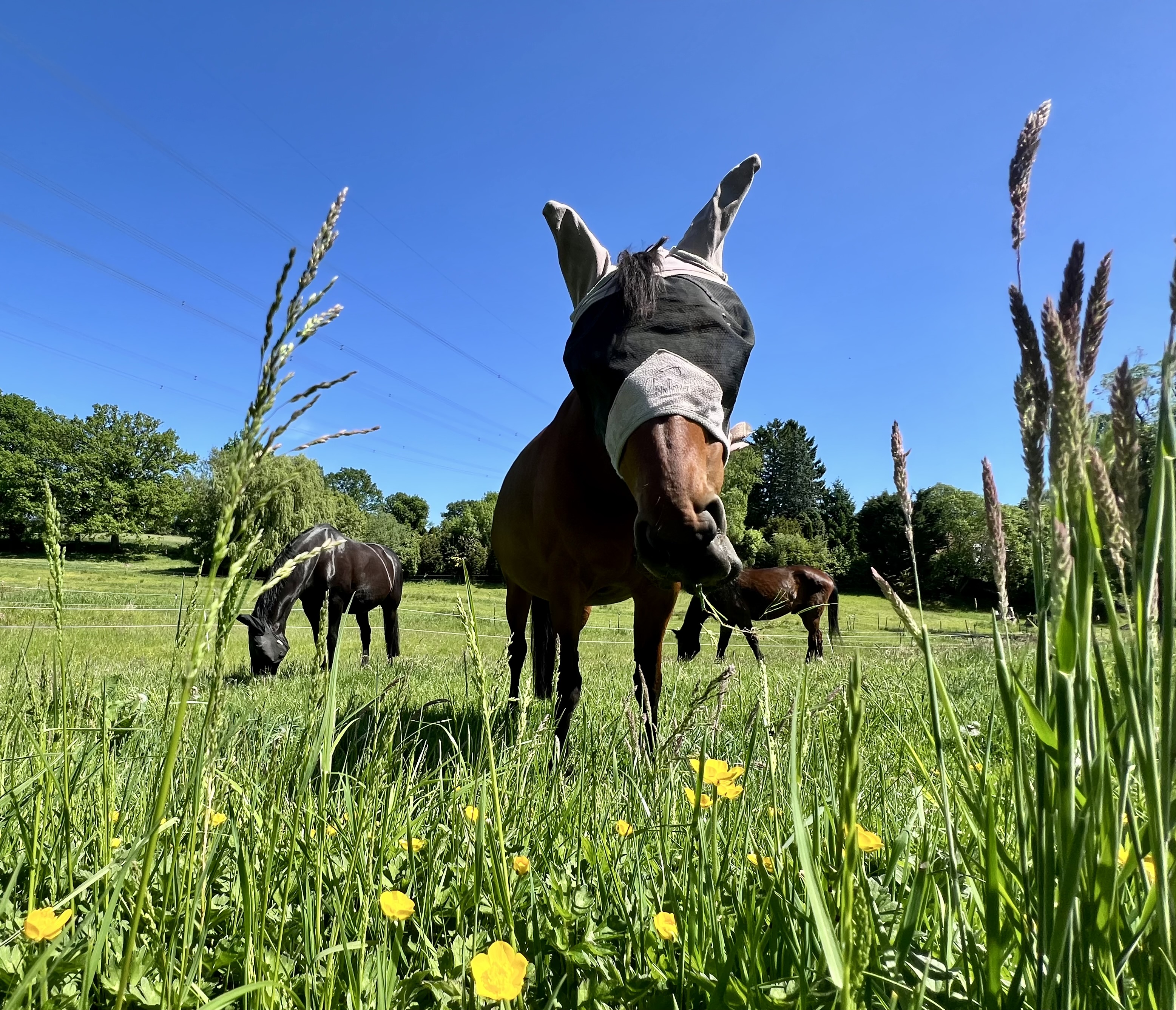
What triggers insect bite hypersensitivity?
Horses with IBH react allergically to the saliva of Culicoides midges (biting midges), less often also to black flies [2]. These tiny insects, only two millimeters in size, are especially active in warm, humid, windless areas, roughly two to three hours before and after sunrise and at dusk.
Among biting midges, only the females suck blood. The actual allergen is a series of proteins in the insect's saliva, and because these proteins are very similar across different biting insects, cross-reactions occur. In advanced stages, affected horses therefore often also react to stable flies (Stomoxys) or horseflies (Tabanidae), sometimes also to lice or environmental allergens. Biting midges remain the main trigger, with black flies in second place [8].
There are no biting Culicoides species in Iceland. That is why imported Icelandic horses are especially at risk: during the formative phase, their immune system never came into contact with the midge and so could not build tolerance. If a horse first meets the allergen at age three or four, an allergy develops instead [8]. Up to 50% of imported Icelandic horses develop it [2].
The lack of early exposure is not the whole explanation, though. There is a clear breed predisposition and clustering in families. Even so, insect bite hypersensitivity is not a hereditary disease in the strict sense: it is not reliably passed from mare or stallion to offspring. According to specialist veterinarians, an estimated 10 to 20% of Icelandic horses kept in Germany are affected [8].
It takes time for the disease to break out. The immune system needs several contacts with the allergen before it overreacts, so insect bite hypersensitivity is very unlikely in a six-month-old foal. In most cases the condition shows up after two to three years of exposure; as a rule of thumb, the age is three to six years. And it gets worse over the years, not better [8].
Insect bite hypersensitivity is an IgE-mediated allergic reaction with massive eosinophil infiltration into the skin [2].
Why chronic cases are harder to treat: At the start, insect bite hypersensitivity is a classic type 1 hypersensitivity: IgE antibodies occupy mast cells in the skin, the allergen binds to them, and the mast cell releases histamine and other mediators. In a long course, the mechanism shifts. In the specialist literature, insect bite hypersensitivity is described as a combined type I/IVb reaction whose course is shaped by eosinophilic granulocytes together with TH2 cells [7]; according to veterinary dermatologists, chronic insect bite hypersensitivity is hardly IgE-mediated anymore and instead runs mostly as a delayed-type, type 4 reaction [8].
This has three practical consequences. Allergy tests become less reliable in horses with chronic disease, because the IgE they measure loses importance. Desensitization approaches work less well. And the itch sustains itself, regardless of whether a midge has just bitten. A horse treated early is therefore a different medical case from one that has rubbed itself raw for four years [8].
The second pillar besides the immune system is the skin barrier itself. Horses with insect bite hypersensitivity have drier skin with less fat in the top layers, and the corneocytes lie farther apart. As a result, allergens penetrate deeper and meet the skin's immune cells more often, which strengthens the allergic response further. The mechanism is the same as in atopic dermatitis (neurodermatitis) in humans and dogs [8].
That is why lipid-replenishing shampoos and care products are part of the treatment for these horses.
Typical symptoms are severe itching, skin rashes and inflammation, mainly at the crest, tailhead and belly midline. Affected horses rub until the skin bleeds, the hair breaks off, and in chronic cases the skin thickens and lichenifies, forming heavy folds.
When does it occur? Depending on the weather, symptoms start in April or May as insects begin to fly, and last until September or October. At first it is often only small bumps (papules) on the crest; only as the itching increases do rubbed spots and open skin follow [8].
Some horses do rub in winter, though. There are two explanations. First, the vicious cycle of secondary infection and itching can keep going if it was never broken in summer, and then the rubbing no longer has an insect bite as its cause at all. Second, insect flight periods have shifted earlier because of warmer conditions, in part already into March, so the recovery phase for the skin is much shorter. The second point is a hypothesis, not a proven cause [8].
The vicious cycle: It starts with the insect bite. Rubbing creates open spots, and the skin surface is not sterile, so bacterial secondary infections develop. These infections trigger itching themselves, the horse rubs more, and the wounds get bigger. At some point you can no longer tell what is cause and what is consequence. With open wounds in summer there is also a risk that flies lay their eggs [8].
That is exactly why it pays to act early: the further the cycle has progressed, the more medication it takes to bring the itch down at all, and the longer it takes [8].

The new immunotherapy: recombinant allergens instead of midge extract
Earlier desensitization attempts with whole-body midge extracts, literally crushed midges, showed no effect beyond placebo level [2]. The problem: besides the actually relevant salivary protein, these extracts contain chitin and a host of other components that dilute the active fraction and can trigger new sensitizations [8].
One important point for context: this is not an argument against desensitization as such. In horses that react to environmental allergens, allergen-specific immunotherapy based on an intradermal test has been used for years. According to the experience of veterinary dermatologists, it helps about two out of three horses, and it is considered neither a medication nor relevant for doping [8]. What was missing was a product that specifically contains the salivary allergens of the midge.
An international research team therefore developed an allergen immunotherapy (AIT) with nine highly pure, lab-made (recombinant) major allergens from the saliva of the Culicoides midge [1]. In a prospective, double-blind, placebo-controlled study, 17 Icelandic horses with insect bite hypersensitivity received either the new AIT (9 horses, 3 injections each in the first year, 2 injections in the second year) or a placebo (8 horses) [1].
The results:
First year of treatment: 67% of the AIT horses, but only 25% of the placebo horses, achieved an improvement in skin lesions of more than 50% [1]. The change was significantly greater in the treatment group.
Second year of treatment: The effect grew stronger. 89% of the AIT horses, but only 14% of the placebo horses, showed more than 50% improvement compared with the baseline year [1]. Owners reported that their horses scratched and rubbed much less.
The immunotherapy influenced the balance between TH1 and TH2 cells and thereby dampened the allergic reaction [1]. Side effects were minimal: a few horses developed swelling at the injection site [1].
Why antihistamines do not work
In a randomized, placebo-controlled, double-blind field study, the oral histamine-1 receptor antagonist cetirizine failed to show a significant improvement in clinical signs in horses with insect bite hypersensitivity [2]. In contrast, wearing sweet itch blankets and stabling led to a clear improvement [2]. This study supports the assumption that a histamine-mediated pathogenesis plays only a minor role in insect bite hypersensitivity, and that other pathomechanisms, above all interleukins such as IL-5 and IL-31, drive the symptoms [2].
Diagnosis: why there is no test for insect bite hypersensitivity
Anyone who takes a rubbing horse to the vet often expects a test that spits out “insect bite hypersensitivity.” There is no such test. The diagnosis is a clinical one: it comes from history, seasonality, location and the exclusion of other causes of itching [8].
The itch work-up
Itching is a cardinal symptom with many possible causes. Specialist dermatologists work through them systematically in this order [8]:
- Ectoparasites: surface samples of the skin
- Endoparasites: especially when the horse rubs the base of the tail
- Bacterial infections: among others Dermatophilus, which causes itching at first and, in a more advanced stage, rather pain
- Fungal infections: in horses usually not intensely itchy, but they need to be ruled out so that the horse is not treated for allergy for years
- Only after that: sterile conditions that trigger itching, above all allergic dermatitis
Then there are the type and location of the changes: scaly, nodular, with comedones, painful? Crest plus tailhead fits an allergy. If the girth area is affected too, it can go in another direction [8].
And not every case of rubbing is itching. Pain or abnormal sensations, such as a tingling like a foot that has fallen asleep, also lead to rubbing and are not insect bite hypersensitivity. Chronic stress can contribute to itching via pro-inflammatory messenger substances, but does not explain insect bite hypersensitivity on its own [8].
Why the blood test is not an allergy test
The most common misconception concerns the blood test for allergen-specific IgE. It measures something real, but it does not answer the question people ask of it [8]:
- In humans, there are thresholds above which an IgE value counts as abnormal. In horses, no such cutoffs exist.
- The test measures IgE circulating freely in the blood. What matters for the disease, though, is IgE bound to mast cells: only when an allergen bridges two bound molecules does the mast cell release histamine.
- Free IgE has a half-life of only hours to a few days. It rises in spring and falls in winter: every horse that is exposed to biting midges carries such antibodies in summer, healthy and affected alike.
- The test for horses long relied on monoclonal antibodies and was therefore less specific than the versions for dogs and cats.
One more practical recommendation that hardly anyone knows: a worm burden raises IgE levels nonspecifically. If you have a blood test done, you should deworm the horse thoroughly about two weeks beforehand to avoid false positive results [8].
The intradermal test
Among veterinary dermatologists, the intradermal test is considered the gold standard, because it tests the affected organ itself: a small area on the neck is clipped, the allergens are injected into the skin, and if there is a reaction, a wheal forms. Unlike in humans, horses, dogs and cats rarely react anaphylactically, so the test is considered safe [8].
You should still know one limit: mast cells are unevenly distributed in the skin. At a spot with few mast cells, the reaction is small even though the right allergen was hit. So even the best available test replaces neither the diagnosis of exclusion nor the history [8].
Molecular allergy diagnostics
A newer option is a serological test that works with individual, recombinantly produced allergen components instead of whole-body extracts. According to the manufacturer, besides environmental allergens it also detects components of biting midges (Culicoides), stable flies (Stomoxys) and black flies (Simulium), and is supposed to make it possible to tell true sensitization apart from mere cross-reactivity [9].
The appeal lies in standardization: instead of “reacts somehow to biting midges,” it would be possible to determine which individual proteins a horse is sensitized to, which would improve the composition of a later immunotherapy. How well this proves itself in everyday practice with horses remains to be seen; independent comparison studies against the intradermal test are still lacking. What stands out is the direction: diagnostics and therapy both replace the crushed midge extract with defined single allergens.
What this means for you
A blood test alone does not prove insect bite hypersensitivity, and it does not rule it out either. If you have your horse tested, you should know beforehand which question the test is meant to answer, and deworm the horse first. The diagnosis comes from history, seasonality, location of the lesions and the exclusion of parasites and infections [8].
What you can do now: the basic strategy
Treatment currently consists mainly of adequate insect protection [2]. A German questionnaire study of 404 horses with insect bite hypersensitivity found that 72.8% of the horses improved with treatment, with sweet itch blankets the most effective at a 70.3% success rate [3]. Biting midges now also transmit the Shamonda-like virus and mosquitoes the West Nile virus, which is one more reason for consistent protection.
Insect protection in practice:
- Sweet itch blankets made of tightly woven material that cover the mane, tail, belly and, ideally, the head too
- Permethrin or citriodiol as repellents, applied directly to the skin or in impregnated blankets. Which product suits your horse and how to use it is best clarified with your vet [2]
- Stalling during the peak activity times of biting midges (dusk, early morning)
- A fan or open windows in the barn aisle, not in the stall. Biting midges and black flies are weak fliers and cannot make headway against a breeze. Drafts are considered unproblematic for a healthy horse, and the insect load is the bigger problem [8]
- Pasture management: use paddocks between 10 a.m. and 4 p.m. and pick up manure daily (breeding sites). When choosing a paddock, keep in mind that biting midges prefer damp hollows and standing water, while black flies prefer running water. Ideally, the pasture is far from both, and you set up a water trough instead [8]
- Barn climate: reduce moisture. In warm, humid air, insects move into the barn in greater numbers [8]
One detail that is often overlooked: new eczema spots can develop along the seams of the blanket, and nylon can add to sensitization. If your horse gets better in the old spots but suddenly starts rubbing at new trouble spots, turn the blanket inside out. This works well in practice. Some horses don't tolerate the blanket at all and destroy it regularly. It is still worth trying, because a blanket that works replaces medication or greatly reduces it [8].
Local skin care:
A study of 28 horses showed that a cream containing omega-3 fatty acids (eicosapentaenoic acid and docosahexaenoic acid), urea and glycolic acid improved the severity of skin lesions [4]. A topical oil made from camphor, lemongrass, lemon oil, peppermint and patchouli also showed efficacy in a study [2].
When the itching is already there
Insect protection is the foundation, but it doesn't help a horse that has already rubbed itself raw. At that point, the goal is to interrupt the itch.
Washing and skin care
Shampooing cools the skin, removes crusts and treats existing secondary infections. Lipid-replenishing shampoos also support the damaged skin barrier [8].
Corticosteroids: early and topical rather than late and systemic
Corticosteroids have a bad reputation among horse owners, and for good reason: there is an association with laminitis. Veterinary dermatologists and equine clinicians still argue clearly here: in a horse with severe itching, giving corticosteroids is an animal welfare measure [8]. Products containing corticosteroids are prescription-only in Germany and the EU. Choice, use and dosage belong in the hands of the treating vet.
The reason lies in the extent of the suffering. From human medicine we know that severe itching is barely bearable. The horse rubs until it hurts, because pain is easier to endure than the itch. A horse that gets no rest for years, or through an entire season, is a seriously ill animal [8].
In practical terms, that means stepping in early. If you use a cream or spray containing corticosteroids at the first sign of itching, you need less overall and for a shorter time. Often, after the initial phase, you can reduce to once or twice a week over the summer. If you wait until the horse is hairless and sore, you need significantly more medication and it takes longer until the itch responds at all. The corticosteroid tablet remains the exception [8].
How high the individual laminitis risk is depends on the horse. Extra caution is needed in ponies, hardy breeds and horses with insulin dysregulation. This is a trade-off to make together with your vet, never alone.
Spot-ons
Depending on the product, spot-on products are applied weekly or every 14 days and are meant to prevent insects from biting in the first place. In advanced stages of the disease, they become less and less effective [8].
Supportive feeding in insect bite hypersensitivity
A deficiency of zinc, copper and biotin can trigger allergic skin reactions [2]. Excessively high calcium levels in the feed (for example from forb- or legume-rich hay) impair the absorption of trace minerals and macrominerals. So does an oversupply of grain containing phytic acid, such as corn or barley [2].
Active ingredients with moderate evidence:
Omega-3 fatty acids (EPA and DHA) are anti-inflammatory and support the barrier function of the skin. Studies showed improvement of skin lesions, though with a limited effect on the underlying itch [4]. Sources: flaxseed oil, highly purified algae oil, fish oil.
Two things to keep in mind about expectations: you should feed it for six to eight weeks before you can assess the effect at all, and in an acute, severe flare-up omega-3 brings nothing in the short term. Based on practical experience, the benefit is that less medication is needed when it is combined with medical treatment [8].
Zinc is essential for wound healing and immune regulation, and skin health gets worse when there is a confirmed deficiency. Targeted supplementation therefore only makes sense after blood work and in consultation with your vet. The amount depends on the actual gap in supply from the base forage, rather than on a flat daily dose.
Copper is a cofactor for enzymes in collagen metabolism and skin pigmentation. Watch out: zinc and copper should be supplied in a balanced ratio (roughly 4:1 to 6:1).
Who is it useful for? Horses with a confirmed deficiency (blood work) or with inadequate supply from the base forage. Especially in horses with IBH during an intense flare-up, targeted supplementation can support recovery. Talk to your vet before giving it. Oversupply can trigger antagonisms (e.g., too much zinc inhibits copper absorption).
Don't expect miracles: Supplements ease symptoms and support the skin barrier, but they do not replace insect protection. Without a sweet itch blanket and good management, the distress stays high.
Outlook: other research approaches
Besides allergen immunotherapy, a second approach with a completely different mechanism is being pursued: therapeutic vaccines against the body's own inflammatory mediators interleukin-5 (IL-5) and interleukin-31 (IL-31). IL-5 is the main regulator of eosinophils, whose massive infiltration drives the skin inflammation. Unlike desensitization, this approach does not try to make the immune system tolerant of the allergen. Instead, it blocks the effector arm of the inflammation.
In a placebo-controlled study with 34 Icelandic horses (19 vaccinated, 15 placebo), equine IL-5 was coupled to a virus-like particle and given as a vaccine. The horse then produces antibodies against its own IL-5. In 47% of the vaccinated animals, symptoms improved by at least half, and in 21% by at least three quarters. In the control group, 13% reached half and no horse reached three quarters [6]. A follow-up in the second vaccination year suggests that the inflammatory eosinophils shift into a resting phenotype [7].
In parallel, a candidate against IL-31 is in development, and other groups are working on inhibiting antibodies against equine IL-5 as passive immunization [5]. All of these approaches are still in development. Whether and when a product will be licensed in Germany is an open question. We will update this section as soon as the approval status changes.
Bottom line
Insect bite hypersensitivity remains a chronic condition with no complete cure, but the treatment options are getting better. The new allergen immunotherapy with recombinant Culicoides allergens is the first desensitization to show significant success in a placebo-controlled study. Until it is approved for the market, consistent insect protection with sweet itch blankets, repellents and adapted horse keeping is the foundation. Through feeding, you can support the skin barrier with omega-3 fatty acids, always in consultation with your vet. The earlier you act, the better you can ease the chronic course.
Frequently asked questions about insect bite hypersensitivity in horses
What is insect bite hypersensitivity and how does it develop?
Insect bite hypersensitivity (IBH) is an allergic reaction to the saliva of Culicoides midges (biting midges), less often also to black flies [2]. The actual allergen is a group of proteins in the saliva of the blood-feeding females. Because these proteins are very similar across different biting insects, affected horses in the advanced stage often also react to stable flies or horse flies [8]. The immune system needs several contacts with the allergen before it overreacts, so it takes a while before the disease appears [8].
Why do some horses get insect bite hypersensitivity and others don't?
There is a clear breed predisposition and a clustering in families, even though IBH is not a classic hereditary disease [8]. Imported Icelandic horses are at particular risk: Iceland has no biting Culicoides species, so their immune system never had contact with the midge during the formative phase and could not build up tolerance [8]. Up to 50% of imported Icelandics are affected [2]. The skin barrier plays a second role: horses with IBH have drier skin, which lets allergens penetrate deeper and amplify the allergic response [8].
How do I recognize insect bite hypersensitivity in my horse?
Typical symptoms are severe itching, skin rashes and inflammation, mainly at the crest, tailhead and ventral midline. Affected horses rub until the skin bleeds, the hair breaks off, and in chronic cases the skin thickens and lichenifies, forming heavy folds. At first, it is often only small bumps (papules) on the crest. Rubbed areas and open skin only appear as the itching increases [8]. A reliable diagnosis, however, only comes from the history, seasonality, location and the exclusion of other causes of itching. There is no single test for it [8].
When does insect bite hypersensitivity start in the year?
Depending on the weather, symptoms begin in April or May when the insects start to fly, and last until September or October [8]. Because of warmer conditions, flight times have in part already shifted into March, so the recovery phase for the skin is shorter. This is, however, a hypothesis and not a proven cause [8]. Some horses also rub in winter if the vicious cycle of secondary infection and itching was never broken in summer [8].
What helps with insect bite hypersensitivity?
Treatment currently consists mainly of consistent insect protection [2]. In a German questionnaire study of 404 horses, 72.8% improved with treatment, and sweet itch blankets were the most effective, with a 70.3% success rate [3]. This includes fine-mesh sweet itch blankets, repellents such as permethrin or citriodiol, keeping horses stabled during peak flight times and well-planned pasture management [2][8]. The earlier you act, the better you can soften the chronic course [8].
Which ointment or cream helps with insect bite hypersensitivity?
For itching that is already present, specialist vets argue for early, local corticosteroid treatment as an animal welfare measure, because if you start with a corticosteroid cream or spray at the first sign of itching, you need less overall and for a shorter time [8]. Corticosteroid products are prescription-only in Germany and the EU, and the choice of product, its use and the dosing belong in your vet's hands. For skin care, a cream with omega-3 fatty acids, urea and glycolic acid showed an improvement of skin lesions in a study of 28 horses [4]. Lipid-replenishing shampoos additionally support the impaired skin barrier [8].
Does a vaccination help against insect bite hypersensitivity?
No approved vaccination exists in Germany so far, but research is ongoing. In a placebo-controlled study of 34 Icelandic horses, the horse's own interleukin-5 was coupled to a virus-like particle and given as a vaccine, after which the horse produces antibodies against its own IL-5 [6]. In 47% of the vaccinated animals, symptoms improved by at least half, compared with only 13% in the control group [6]. This approach is still in development, and whether and when a product will be approved is open.
What should I feed a horse with insect bite hypersensitivity?
A deficiency of zinc, copper and biotin can trigger allergic skin reactions, so it is worth checking your horse's supply [2]. Omega-3 fatty acids (EPA and DHA) from linseed oil, algae oil or fish oil are anti-inflammatory and support the skin barrier. However, you should feed them for six to eight weeks before you can judge the effect, and during an acute flare they bring nothing in the short term [4][8]. Targeted zinc or copper supplementation only makes sense after blood work and in consultation with your vet, since oversupply can cause antagonisms. Supplements ease symptoms and support the skin barrier, but they do not replace insect protection.
Do antihistamines help with insect bite hypersensitivity?
No. In a randomized, placebo-controlled, double-blind study, the oral drug cetirizine showed no significant improvement of symptoms [2]. Wearing sweet itch blankets and keeping horses stabled, on the other hand, led to a clear improvement [2]. This supports the assumption that histamine plays only a minor role in IBH and that other messengers such as interleukins drive the symptoms [2].
Sources
- [1] Graner A, Mueller RS, Geisler J et al. - Allergen immunotherapy using recombinant Culicoides allergens improves clinical signs of equine insect bite hypersensitivity. Frontiers in Allergy 2024. https://www.frontiersin.org/journals/allergy/articles/10.3389/falgy.2024.1467245/full
- [2] Birkmann K, Fettelschoss-Gabriel A. - Das Sommerekzem - neue Ansätze in Diagnostik und Therapie. Tiermedizin Thieme 2023. https://tiermedizin.thieme.de/pferd-co/fachbeitraege/detail/neue-therapieansaetze-bei-pferden-mit-sommerekzem-912
- [3] Fragebogenstudie zum Sommerekzem bei Pferden in Deutschland [questionnaire study on insect bite hypersensitivity in horses in Germany]. Freie Universität Berlin. https://refubium.fu-berlin.de/handle/fub188/10440
- [4] Friberg, and Logas, (1999), Treatment of Culicoides hypersensitive horses with high-dose n-3 fatty acids: a double-blinded crossover study. Veterinary Dermatology, 10: 117–122. https://doi.org/10.1046/j.1365-3164.1999.00147.x
- [5] Langreder N, Schackermann D et al. - Development of an inhibiting antibody against equine interleukin 5 to treat insect bite hypersensitivity of horses. Scientific Reports 2023. https://www.nature.com/articles/s41598-023-31173-y
- [6] Fettelschoss-Gabriel A, Fettelschoss V, Thoms F et al. - Treating insect-bite hypersensitivity in horses with active vaccination against IL-5. J Allergy Clin Immunol 2018;142(4):1194–1205.e3. PMID 29627082. https://doi.org/10.1016/j.jaci.2018.01.041
- [7] Schwarz E, Jebbawi F, Keller G et al. - Phenotypic Shift of an Inflammatory Eosinophil Subset into a Steady-State Resident Phenotype after 2 Years of Vaccination against IL-5 in Equine Insect Bite Hypersensitivity. Vet Sci 2024;11(10):476. PMID 39453068. https://doi.org/10.3390/vetsci11100476
- [8] Feige K, Volk A - Das Sommerekzem. Podcast „Pferdemedizin heute", episode 28, Gesellschaft für Pferdemedizin, April 19, 2024. Expert opinion of two specialist veterinarians, not a study. https://gpm-vet.de/de/service/podcast/317-28-das-sommerekzem
- [9] Nextmune - PAX Horse Allergy Xplorer (serum test, molecular allergy diagnostics for horses). Manufacturer information, not an independent study. https://nextmune.com/vet-products/pax-horse-allergy-xplorer-serum-test
All medical statements in the text are linked to the corresponding source in this list by inline markers [N]. This article does not replace advice from your vet.